
The home is the first school, and a mother is the first teacher. In the beautiful, intricate architecture of an Armenian family, it is the mother who often acts as the primary guardian of culture, whispering the ancient stories, modeling the hospitality, and weaving the invisible threads that connect her children to their roots. This sacred work goes far beyond learning history; it is about providing children with a deep sense of belonging, resilience, and identity that will anchor them throughout their lives.
“A child is not a vessel to be filled, but a fire to be lit.” — This sentiment rings beautifully true when illuminating an Armenian child’s heart with the traditions of their ancestors.
While our history is vast and our cultural practices numerous, some traditions carry the very heartbeat of our identity. For every Armenian mother navigating modern life, here are ten essential traditions to nurture in your home:
1. The Sweetness of Our Tongue: The Armenian Language
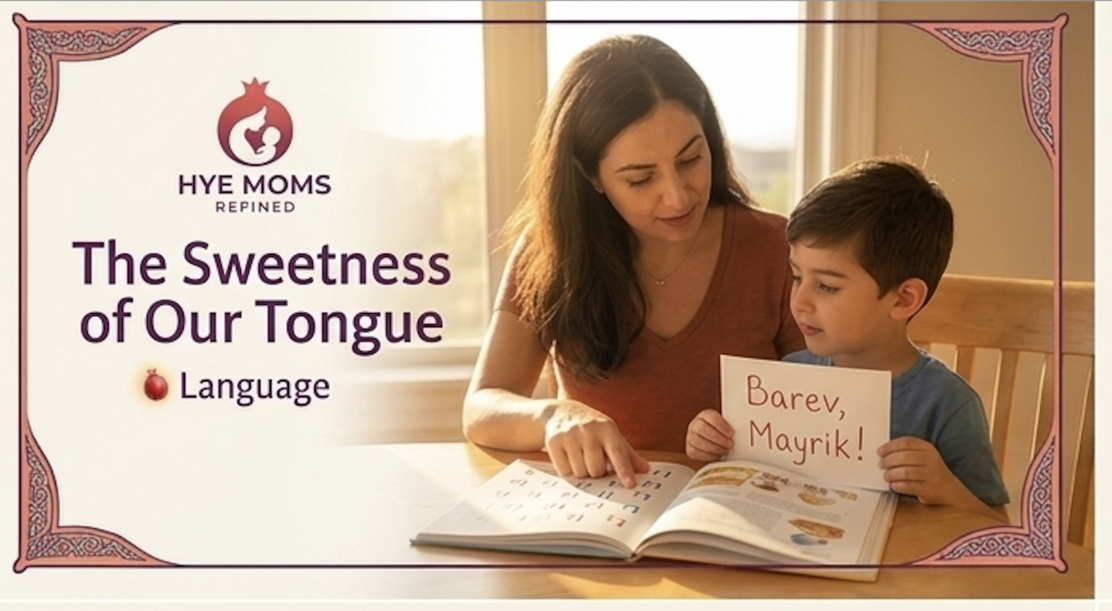
Perhaps the most vital connection to our heritage is the Armenian language. It is a portal into our collective soul. Teaching your children to speak, even just the basics, or to read the beautiful, unique Armenian alphabet, is a gift. The first “Barev,” the ability to understand a story told by a grandparent, or to say a simple prayer, creates an unbreakable bond. The language is the key that unlocks our literature, our music, and our shared understanding.
2. Faith as an Anchor: The Armenian Church
The Armenian Apostolic Church is not just a place of worship; it is the spiritual home of our nation. Even if attendance isn’t weekly, introduce your children to the richness of our faith. Teach them about the spiritual significance of the cross (Khachkar), the beauty of our hymns (sharakans), and the stories of our saints. This tradition provides a moral compass, a sense of community, and a spiritual sanctuary that can provide profound comfort in difficult times.
3. The Open Door: The Art of Armenian Hospitality
The Armenian home is synonymous with hospitality. It is rarely a formal affair, but a spontaneous, generous outpouring of welcome. Teach your kids that when a guest arrives, the table must be filled, coffee must be made, and conversation must flow. This tradition teaches generosity of spirit, social grace, and the profound value of human connection. It reminds our children that a home is most blessed when its doors are open.
 4. A History in Stone: Respect for Armenian Heritage and Monasteries
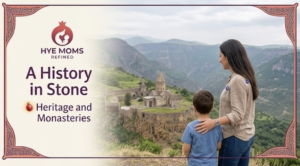
Armenia is an open-air museum. Even if you live far from the Republic, use images, books, or a pilgrimage visit to instil a reverence for our ancient monasteries like Tatev, Geghard, or Khor Virap. Teach your children about our struggles, our triumphs, and the stories behind the Khachkars. Understanding our history gives children a powerful sense of resilience—knowing they are descendants of a people who have endured, created, and survived for millennia.
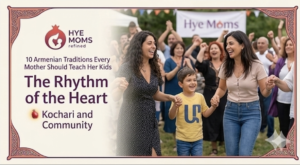
5. The Rhythm of the Heart: Armenian Music and Dance (Kochari)
Armenian folk music and dance, especially the iconic Kochari, are primal expressions of our identity. Kochari is more than a dance; it is a display of unity, strength, and joy. Put on some music, teach your kids the basic steps, and let them feel the powerful, ancient rhythm in their bones. This tradition connects children to the shared cultural language that is spoken at weddings, community gatherings, and on the soil of Armenia itself.
6. The Fruit of Life: The Pomegranate (Nurn)
As symbolized in the Hye Moms logo, the pomegranate is the ultimate symbol of Armenia, representing fertility, abundance, prosperity, and the unity of the Armenian people. Keep pomegranates in your home during their season. Show your children how to open one, marveling at the hundreds of seeds, and teach them that we are like those seeds—distinct, yet unified within the shared fruit of our nation.
7. Blessing the First Grape: The Tradition of Khaghoghorhnek
Participate in, or teach your children about, the beautiful feast of the Assumption of the Holy Mother of God (Verapokhumn Surp Astvatsatsni), where grapes are blessed. This ancient harvest festival teaches children about gratitude for the Earth’s abundance, the sacredness of the harvest, and the church’s role in blessing the essential elements of our lives.
8. The Art of the Table: Making Lavash and Gata
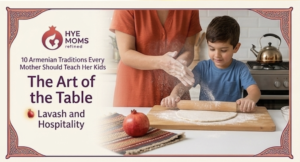
The kitchen is the emotional center of the home, and baking Lavash and Gata are acts of cultural continuity. If you can, take your children to an Armenian bakery or try making Gata at home. Let them feel the dough, smell the vanilla and butter, and learn the story of how Lavash has been baked in a tonir for centuries. The effort of cooking and the joy of sharing these traditional foods are memories that will last a lifetime.
 9. Warding Off Evil: The Power of ‘Acha’ (The Evil Eye)
The belief in the ‘Acha’ or Evil Eye, and the tradition of giving a small, protective blue eye bead (often pinned to a baby’s clothing or stroller), is a beautiful, folk tradition that emphasizes protective care. Teach your kids that this is a symbol of our desire to shield them from negativity and jealousy, and that it is rooted in our culture’s emphasis on the sacredness of protection within the family.
10. The Eternal Loop: The Symbol of Eternity (Arevakhach)
The Armenian Eternity Symbol, often a stylized floral loop or arevakhach, is seen everywhere from stone carvings to jewelry. Teach your children that this symbol represents the eternal nature of the soul, the continuation of life, and the enduring nature of the Armenian spirit. It teaches them that while we may face challenges, our identity and our heritage will live on eternally.
The Path Forward
A mother’s role in this cultural transmission is not about enforcing rigid rules, but about creating an atmosphere of love, pride, and discovery. As the foundation of the Hye Moms community suggests, you are not just raising a child; you are nurturing a link in an eternal chain. The traditions we share today are the memories that will guide our children tomorrow, ensuring that the warm light of our Armenian heritage continues to burn brightly in their hearts.
Which of these traditions do you most look forward to teaching your children?
